Introduction to Iatromathematics
In the Middle Ages and throughout the Renaissance, medicine and astrology were not viewed as separate disciplines. The practice of Iatromathematics (or medical astrology) was a foundational requirement for any respected physician. It was widely believed that the Macrocosm (the universe) reflected directly onto the Microcosm (the human body). To treat a patient without consulting their horoscope was often considered professional negligence.
Did You Know?
Until the late 1600s, standard medical universities across Europe, notably in Italy and France, had dedicated chairs for Medical Astrology.
The Zodiac Man: A Celestial Mapping
The most famous visual representation of this link is the Homo Signorum, or "Zodiac Man." This diagram depicts the human body with each part governed by one of the twelve signs. Each sign of the zodiac transmits its influence to specific organs and physiological systems.
- Aries: The Head and Face
- Taurus: The Neck and Throat
- Gemini: Shoulders, Arms, and Lungs
- Cancer: Breast and Stomach
- Leo: Heart and Spine
- Virgo: Abdomen and Intestines
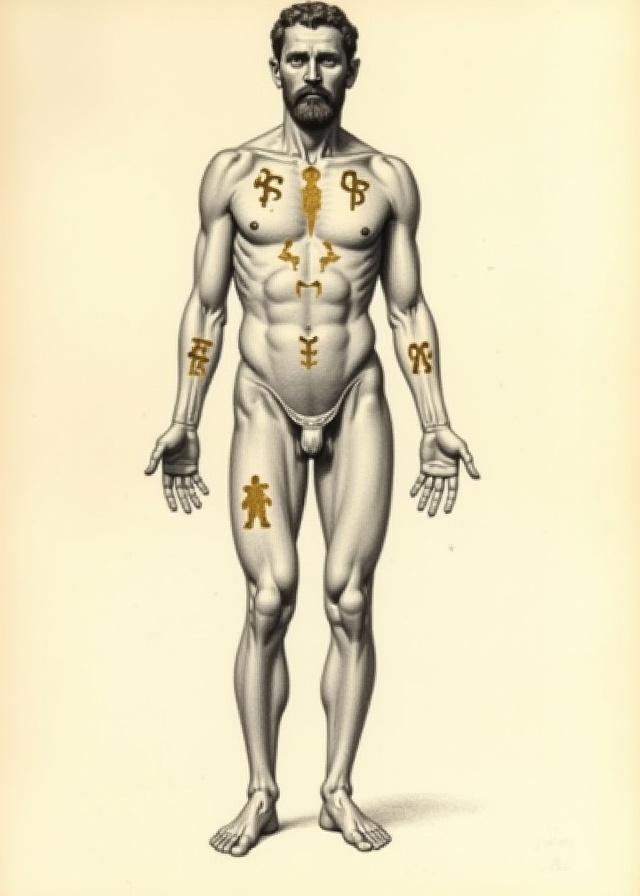
A traditional 'Homo Signorum' reconstruction.
Physicians used this map to determine when to avoid certain surgeries. For instance, it was considered dangerous to perform surgery on a body part when the Moon was in the zodiac sign governing that part.
Planetary Hours and Herbalism
Medicine wasn't just about diagnosis; it was about the timing of the cure. The collection and preparation of herbs were dictates by the Planetary Hours. Each planet was thought to have an affinity with specific plants (e.g., Mars with nettles, the Sun with rosemary).
Nicholas Culpeper and Herbal Astrology
One of the most famous figures in this field, Nicholas Culpeper, published 'The English Physitian' in 1652. He argued that to truly understand an illness, one must understand which planet caused it and which planet could counteract it through its herbal signature.

The Enlightenment Separation
The 17th century marked a terminal shift. With the rise of the Scientific Revolution and the works of figures like William Harvey, medicine began to focus on clinical observation and the circulatory system. Astrology was gradually relegated to the realm of folk medicine and eventually separated entirely from the formal medical curriculum by the early 18th century.